The accelerated depreciation benefits of Cost Segregation can produce a great increase in cash flow for public and private owners of commercial property. Tenants who have an ownership interest in tenant improvements can also benefit from Cost Segregation.
Investors can who did not utilize Cost Segregation to accelerate depreciation the year the property was placed in service can benefit years later, without filing an amended tax return.

Background
It is common practice for those who invest in buildings and improvements to account for their assets as 39-year property for federal income tax reporting purposes (27.5 years for multifamily properties). Recent tax law changes allow for a maximum 15-year depreciable life on some improvements, but what if you could assign and 5 or 7-year life to these assets. What about Bonus Depreciation?
Cost Segregation is an analysis of acquired or constructed buildings and improvements for the purpose of reclassifying a significant portion of the assets from IRS Section 1250 Real Property to Section 1245 Personal Property with lives of 5, 7, or 15 years.
Cost Segregation engineers rely upon the Modified Accelerated Cost Recovery System (“MACRS”) section of the Internal Revenue Code to identify components of the electrical systems, plumbing, HVAC, interior finishes, and site improvements for shorter tax lives. Accelerating the depreciation of these components reduces the property owner’s reported income for the first five to 10 years of the life of the property. The benefit of a Cost Segregation analysis can be quantified as the present value of these tax deferments as compared to tax payments made without a Cost Segregation analysis.
Expertise in Action
Marshall & Stevens has been providing cost segregation analyses since the implementation of MACRS in 1987. We apply applicable tax code, case law, construction knowledge, and decades of experience in this arena in order to provide the insightful and well-documented engineering-based analysis and report that the IRS expects to receive in every Cost Segregation analysis.
Cost Segregation can benefit owners of all commercial property types and does not have to be done the same year as the building and improvements are first capitalized.
Taking it One Step Further
- Clients engage us to provide an estimate of the Cost Segregation analysis while they are bidding to acquire a property, so they understand the potential economic benefit of accelerated depreciation to the investors.
- Beware the acquisition allocation. If you agree to an allocation between real property, personal property and land in the purchase agreement, you cannot restate the allocation in your tax filings. Having us review the allocation prior to execution of the transaction will allow us to advise you of a reasonable allocation of all categories so you don’t miss out on the benefits of Cost Segregation.
- Clients submit annual improvement expenditures for us to determine what costs can be categorized as “repair” (to expense) versus “replacement” (capitalized).
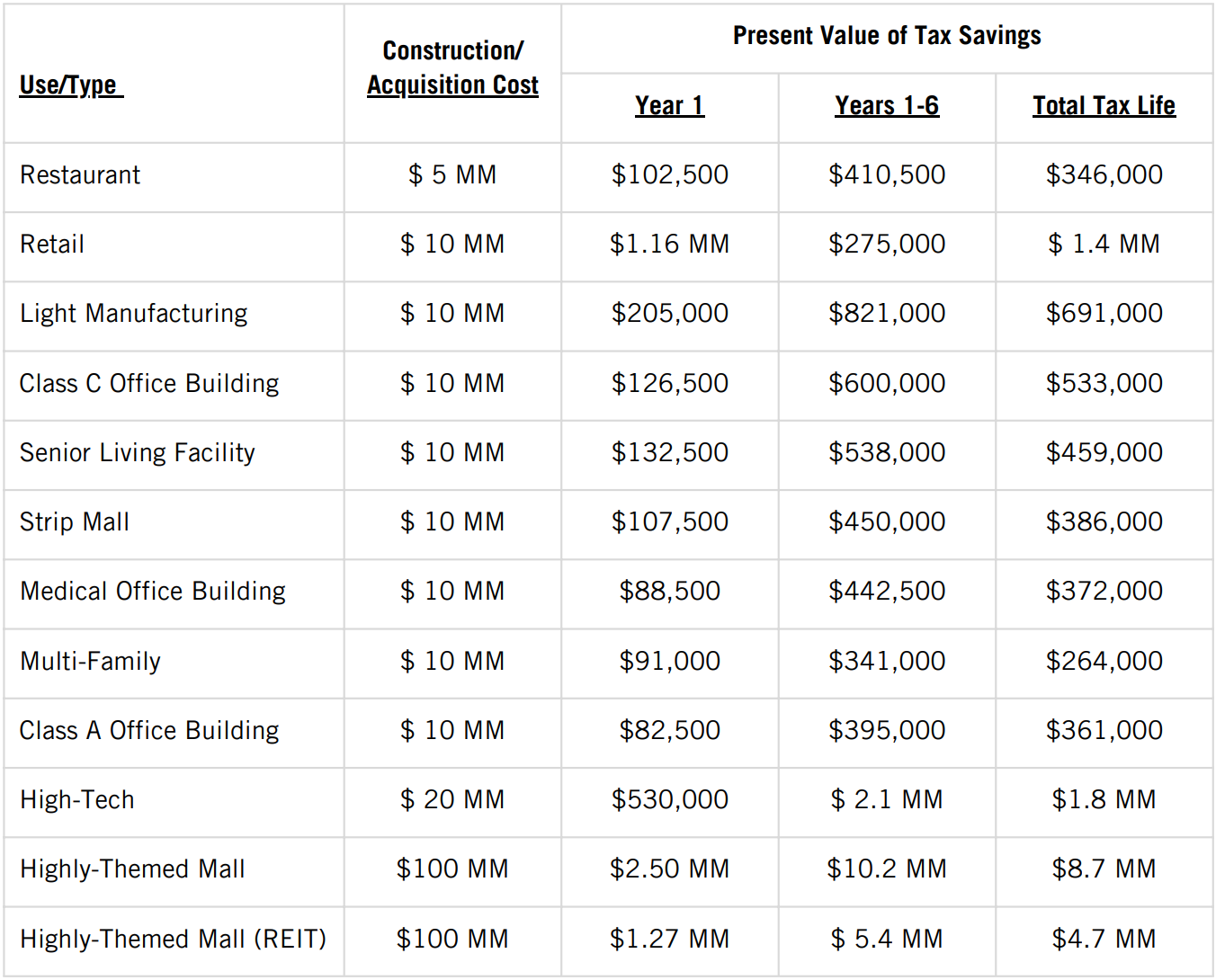
Although every situation is different, the following chart is an example of typical savings one may expect from a cost segregation study:
Once the cost segregation study is complete, the results may be reorganized into:
- Insurable value report
- Property tax report
- Fixed Asset and Deferred Tax Liability/Asset Management reports.
Cost segregation studies should be initiated as early in the construction or acquisition process as possible to obtain maximum savings. Great savings are available once the project or the acquisition is complete, and in many cases, years after completion, but why wait?
Insurance Savings
Many insurance policies exclude or reduce coverage for building components at or below ground level, such as underground utilities, foundations, site preparation, offsite costs, and parking lots. We can utilize the Cost Segregation analysis to produce an Insurable Value Report that identifies and values the assets you will insure and those not to insure.
Property Tax Savings
Non-Value-Added costs are a normal part of the construction process. When a property owner constructs or renovates a facility, Cost Segregation can identify Non-Value-Added costs. When a property owner acquires a facility, cost segregation can identify Super-Adequacy costs. Based on local or state tax code, these costs may be removed from a facility’s property tax basis.
Transfer Tax Savings
Many states tax the transfer of a deed based on the value of the real property in the transaction. Although State and Federal definitions of personal property may be substantially different Cost Segregation analysis may reduce this tax through the identification of intellectual property and personal property prior to filing the closing documents.